Quick answer: a new website is only the right answer when the current one is genuinely blocking the business. Before rebuilding, we check the commercial problem, what already works, mobile usability, trust, search visibility and what success will actually be measured against.
“We need a new website” is often written into a brief before anybody has diagnosed the problem. Sometimes the brief is right. Sometimes the cheaper and safer move is to repair the journey that is already there.
1. What is the website failing to do?
Start with one plain-English problem. Are people not finding the business? Are they finding it but not enquiring? Does a strong company look weaker online than it does in real life? Is the site difficult to update? Those problems need different solutions.
2. What is already working?
Existing rankings, useful pages, backlinks, enquiry routes and familiar navigation have value. A rebuild that throws them away can create a bigger problem than the one it was meant to solve. Before changing URLs or information architecture, record what is already earning visibility and action.
3. Can the mobile journey be repaired?
Mobile exposes weak hierarchy quickly. We check the first screen, navigation, text size, spacing, calls to action, forms and whether a visitor can understand the offer without hunting. If those issues can be fixed cleanly inside the current site, rebuilding the whole platform may be unnecessary.
4. Is the problem trust, content or technology?
A website can feel dated because the photography is weak, reviews are buried or the copy says very little. Changing CMS will not solve that. Equally, there are themes and page builders where every sensible improvement becomes disproportionately expensive. That is when the technology itself becomes part of the case for rebuilding.
5. What happens to search visibility?
Before moving pages, check Search Console, indexed URLs and the queries already generating impressions. Preserve valuable URLs where possible and map any necessary redirects before launch. A prettier website that loses established organic visibility is not an upgrade.
6. What will be better after the work?
Define the intended change: clearer enquiries, better mobile engagement, stronger local discovery, easier product choice or simpler website management. That gives the project a commercial test beyond “it looks newer”.
Keep it, fix it or rebuild it
That is the decision framework we use in the free website review. If we cannot explain why a rebuild is the sensible commercial option, we should not be selling one. See our free website review or examples in selected work.
A practical pre-rebuild checklist
| Check | Evidence to capture | Why it matters |
|---|---|---|
| Search | Top landing pages, queries and indexed URLs | Protect existing visibility before changing structure. |
| Mobile | First screen, menu, CTA and form behaviour | Shows whether the problem can be repaired without replacing the platform. |
| Trust | Reviews, credentials, case studies and photography | A weak proof layer can make a sound website feel dated. |
| Measurement | CTA clicks, calls, forms and successful submissions | Defines what “better” will mean after the work. |
For local service businesses we also check whether the service and location are visible early enough. For ecommerce we add catalogue, product-data and checkout checks before calling the storefront itself the problem.
Herts Cupping
Reorganise the site around what people feel and how they book, rather than asking them to understand treatment terminology first.
View case study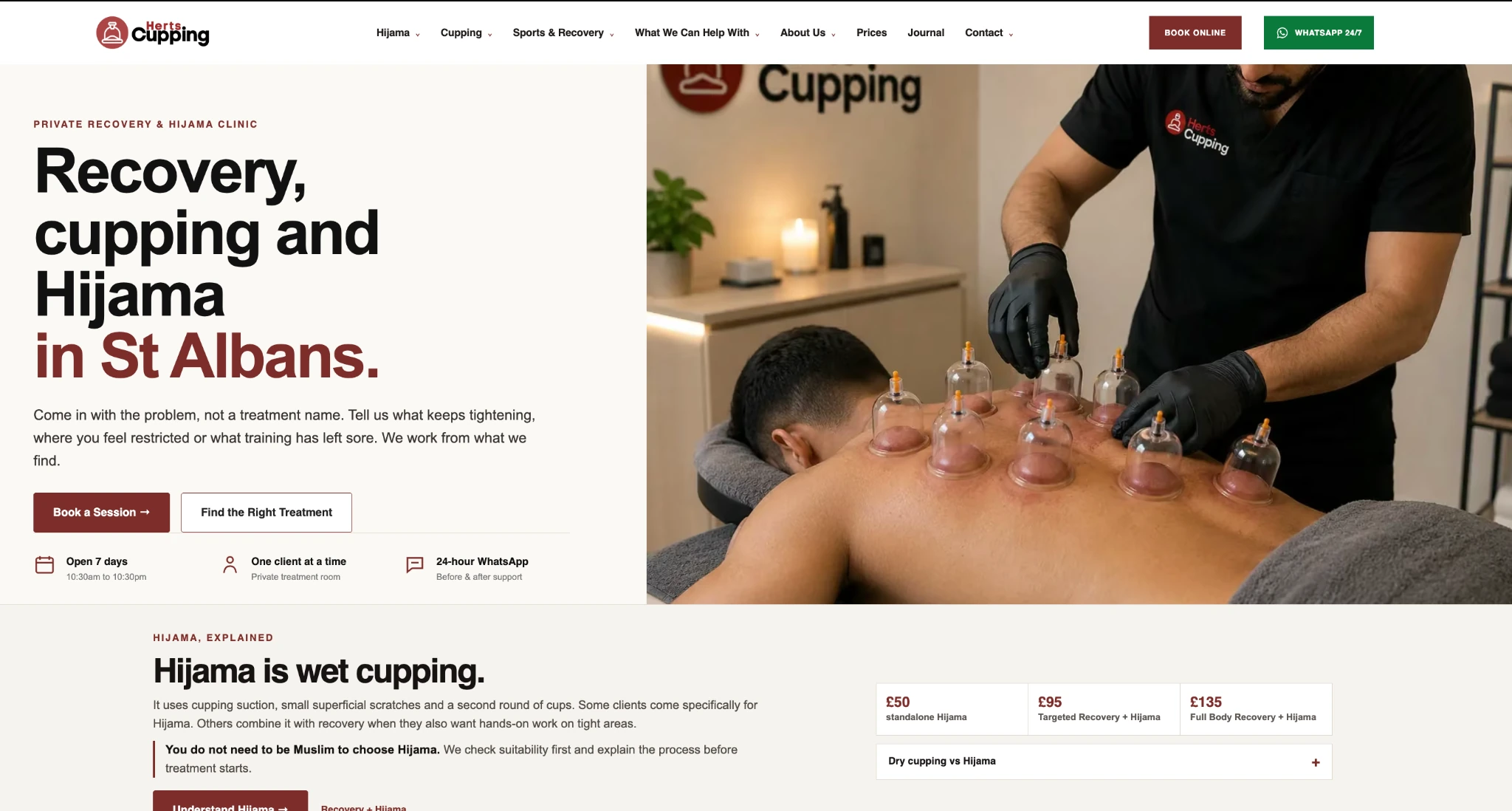
Want this applied to your business rather than just explained?
WebsitesCommon questions
How do you know when a website needs rebuilding?
When the existing structure, platform or design system makes the required commercial improvements disproportionately difficult, or when a major change of proposition or architecture cannot be handled cleanly in the current site.
Can you improve a website without replacing it?
Yes. A fix sprint is specifically for sites that are fundamentally sound but need focused improvements to messaging, mobile UX, conversion or key templates.
Will a rebuild affect SEO?
It can. Existing URLs, Search Console data, backlinks and internal linking should be reviewed before changing the structure, with redirects planned where URLs must move.