Quick answer: many local businesses do not need a bigger SEO package first. They need the website, Google Business Profile, reviews, service-area relevance, Search Console and enquiry tracking connected properly.
1. Complete the Google Business Profile
Categories, services, opening hours, photos, reviews and the linked website should accurately describe the business. The profile and website should reinforce one another rather than tell slightly different stories.
2. Make location and service relevance obvious
A visitor should not have to reach the footer to discover where you work. Explain the actual service area naturally on relevant pages. Avoid dozens of near-identical town pages that simply swap place names.
3. Put reviews where customers hesitate
Reviews help both prominence and conversion, but presentation matters. Surface credible review proof near important decisions rather than hiding it on a standalone testimonials page.
4. Use Search Console before guessing
Search Console shows which queries and pages already have traction. That can reveal service terms, nearby locations and pages that deserve improvement before creating more content.
5. Track the enquiry, not just the ranking
A top position is not valuable if the landing page is unclear or the contact journey fails on mobile. Track calls, forms and other meaningful actions so visibility work remains connected to business outcomes.
See how we connect website structure, booking and local relevance in the Herts Cupping case study, or explore our Google visibility service.
A sensible local visibility sequence
- Fix the entity basics: business name, category, services, location and opening information should agree across the website and Business Profile.
- Fix the landing pages: each important service needs a useful destination, not a paragraph hidden on the homepage.
- Surface real proof: reviews, work, credentials and service-area evidence should support the decision.
- Use Search Console: improve pages already earning impressions before creating twenty speculative location pages.
- Measure enquiries: rankings are useful only when the relevant traffic turns into calls, bookings or forms.
For our local strategy, Hertfordshire and St Albans are deliberate core pages. We would rather make those genuinely useful before duplicating them across every nearby town.
Herts Cupping
Reorganise the site around what people feel and how they book, rather than asking them to understand treatment terminology first.
View case study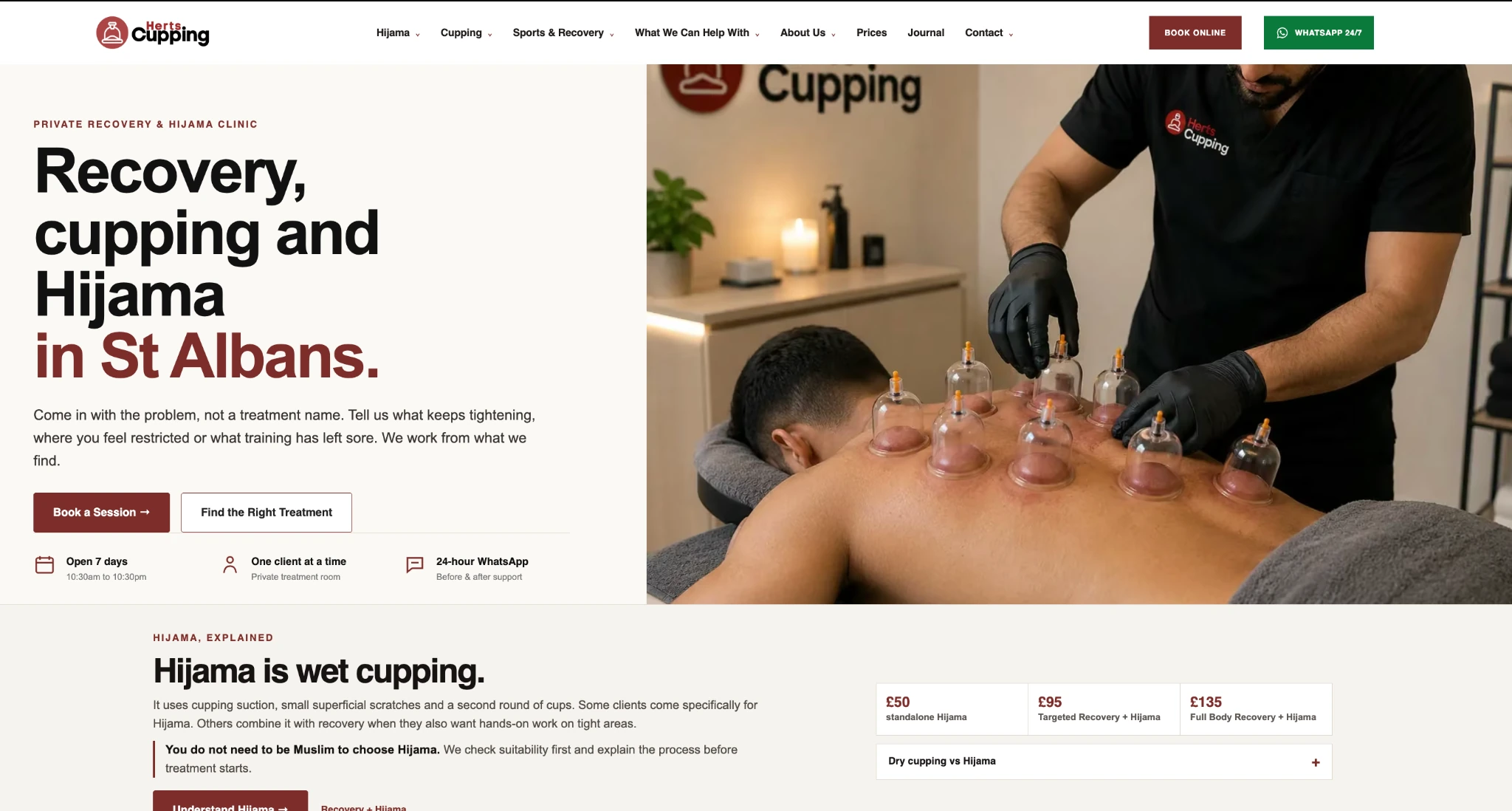
Want this applied to your business rather than just explained?
Google visibilityCommon questions
What should a local business optimise first?
Make the Google Business Profile complete, ensure the website clearly explains services and locations, build genuine review proof, connect Search Console and track enquiries.
Do I need a page for every Hertfordshire town?
No. Create a location page only when it can be genuinely useful and distinct. Thin pages that only swap town names are not a sensible long-term strategy.
How long does local SEO take?
It depends on competition, current authority, reviews, website quality and the query. We do not promise ranking dates; we measure visibility and enquiries over time.