Before hiring a web designer, do not start by asking which platform they use or how quickly they can make the homepage look modern. Start by finding out how they think, what you will own, who will actually do the work and how they connect design to search, conversion and the commercial reality of your business.
A website can look impressive and still be the wrong website. The questions below are designed to expose the difference between someone who can produce pages and someone who can help you make better digital decisions.
1. What do you need to understand about my business before you start designing?
A strong answer should go beyond your logo, preferred colours and list of pages. The designer should want to understand your customers, the problem you solve, how people currently find you, what they need to trust, the actions you want them to take and where the current journey is failing.
If the discovery process is mainly about visual preferences, the project risks becoming decoration rather than commercial design.
2. Will you challenge my brief if you think it is wrong?
This is one of the most useful questions you can ask. You are hiring outside expertise because you do not necessarily have all the answers already.
A senior partner should be comfortable saying that a requested feature is unnecessary, that a rebuild is premature, or that the real issue sits somewhere else. That could be the offer, customer journey, local visibility, product data, checkout, tracking or even the way enquiries are handled after they arrive.
3. How do you decide whether I need a new website or improvements to the existing one?
There should be a diagnosis before a rebuild. Ask what they would review first and what would make them recommend keeping, fixing or replacing the current site.
At FifteenFold, this is why we offer a free keep, fix or rebuild website review. A new build should be the answer only when the evidence points there.
4. How will the website help people take the next step?
Listen for discussion of customer intent, trust, proof, calls to action, mobile behaviour, forms, pricing, service architecture and friction. Conversion is not something that should be added after the visual design has been approved.
For many small businesses, the most commercially important question is not “does this look premium?” but “does a first-time visitor know what to do next?”
5. What SEO foundations are included in the build?
Web design and SEO are different disciplines, but a professional build should not create avoidable search problems. Ask about page structure, titles and descriptions, headings, internal links, indexability, canonical URLs, sitemap handling, image optimisation, mobile performance, analytics and Search Console.
Be cautious if SEO is described only as “adding keywords”.
6. How do you approach mobile design?
“Responsive” is not enough. Ask whether the actual mobile buying or enquiry journey is designed deliberately. Navigation, sticky actions, form length, readability, proof, image weight and content order can all need different decisions on a phone.
A desktop layout squeezed into a narrow screen is not mobile-first design.
7. Who owns the domain, website content and accounts?
You should know which accounts remain in your business name and what happens if the relationship ends. Ask specifically about your domain registrar, hosting, WordPress or ecommerce admin access, analytics, Search Console, Merchant Center, advertising accounts, email systems, images, copy and any paid software licences.
Where possible, business-critical accounts should be owned by the business, with suppliers granted appropriate access rather than owning the account on your behalf.
8. Will I be able to edit normal business information myself?
This matters more than people realise. Ask how you would change prices, service information, testimonials, team details, calls to action, FAQs, case studies and articles after launch.
A well-built content system should not require a developer or theme deployment every time a heading or price changes. The interface should match the way the business actually maintains information.
9. Who will actually do the work?
If you are buying because of the person on the sales call, find out whether that person stays involved. Agencies can have excellent teams, but you should understand the hand-off.
Ask who is responsible for strategy, design, development, SEO foundations, QA and post-launch support. “Senior-led” is useful only if the senior person remains close enough to influence the important decisions.
10. Can you show me the thinking behind your work, not just screenshots?
A portfolio should demonstrate judgement. Ask what problem a project was solving, why the structure was chosen, what changed for mobile, what evidence was prioritised and what trade-offs were made.
Beautiful mock-ups are useful, but they do not tell you whether the designer understands customer decisions, operational constraints or commercial outcomes.
11. What happens if the website is not the main problem?
This question is especially important for established businesses and ecommerce companies. More traffic, a new theme or a prettier product page will not fix every issue.
The real constraint may be product data, Merchant Center, feed quality, offer positioning, checkout friction, catalogue structure, analytics or a disconnect between marketing and the website. A broader digital partner should know when to look beyond the page itself.
12. What happens after launch?
Ask who handles updates, backups, security, plugin maintenance, content changes, analytics checks, conversion improvements and further development. Also ask what is included and what becomes chargeable.
A launch date is not the end of the customer journey or the search journey. It is the point at which real behaviour starts producing useful evidence.
13. How do you test before launch?
A credible answer should include real-device or breakpoint testing, forms, navigation, links, tracking, page speed basics, key browser checks and search/indexing checks. Ecommerce work should also include product, basket and checkout testing where relevant.
QA should be part of delivery, not something the client is expected to discover after launch.
14. How will you tell me if something is not worth paying for?
This may be the most revealing question of all. Good consultancy is partly about deciding what not to do.
You want a partner who can prioritise, explain trade-offs and protect budget. Sometimes the right answer is a smaller fix, a different sequence or a problem outside the website entirely.
A simple way to compare web designers
When comparing proposals, score them against five areas:
- Understanding: do they understand the business problem?
- Judgement: will they challenge weak assumptions?
- Ownership: will you retain control of important assets and accounts?
- Delivery: is the build, QA and post-launch process clear?
- Depth: can they see beyond visual design when the problem crosses SEO, ecommerce, data or conversion?
What FifteenFold believes you should be buying
We think a website project should give you more than production capacity. You should be buying judgement about what to build, what to prioritise and how the website fits into the wider digital operation.
FifteenFold combines website delivery with senior ecommerce experience across UX, CRO, product data, Google Shopping, Merchant Center and feeds. That means we can look at what happens before the click, after the click and behind the website, rather than treating every business problem as another redesign.
If you are comparing suppliers and are not sure what you actually need, tell us the problem in plain English, or start with the free website review.
Frequently asked questions
Should I hire a freelancer or a web design agency?
Neither model is automatically better. Compare who will actually work on the project, the depth of experience you will have access to, accountability, availability and whether the delivery process suits your business.
Should I choose a web designer based on price?
Price matters, but compare scope and decision-making quality rather than headline cost alone. A cheap build that needs replacing quickly can cost more than a smaller, better-planned project.
Do I need to prepare a full website brief first?
No. A good senior partner should be able to help shape the brief. You should be able to start with the business problem, customer, objectives and constraints.
Automotive decision platform
Make the decision itself clear, show the assumptions and put useful evidence before a sales route.
View case study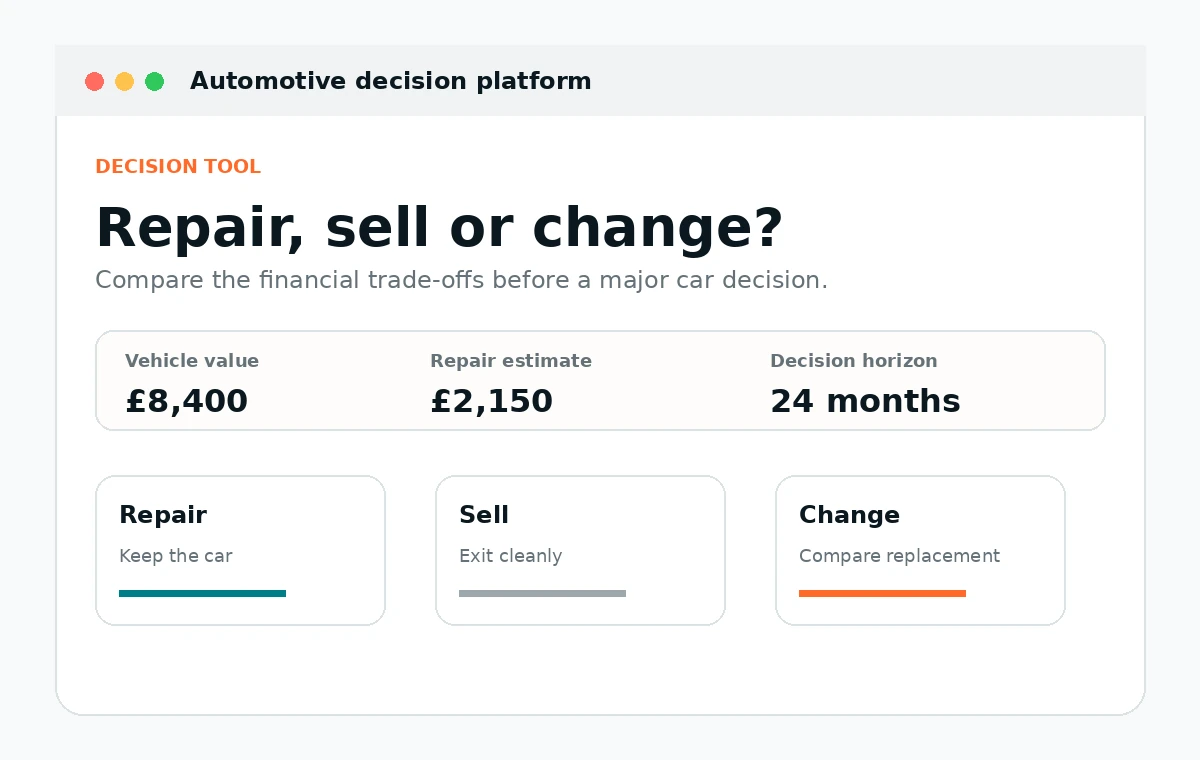
Want this applied to your business rather than just explained?
Websites