My short answer: product data is the connective tissue of ecommerce. If titles, identifiers, variants, categories, availability or attributes are wrong, that bad information can surface in your store, ads and marketplaces at the same time.
This is one area where my enterprise product-data experience changes how I look at a website. I do not see the storefront as an isolated layer.
Google can only work with what you send
If a product title is vague, a GTIN is missing, availability is stale or product type is poorly mapped, the platform has less reliable information to match and present the item. “Feed optimisation” simply means improving that information and the rules around it.
Customers feel data problems too
Wrong colour names, duplicated variants, missing dimensions or inconsistent condition labels create friction on the site itself. Good data is not back-office housekeeping. It affects the buying experience.
Fix the source where possible
I prefer correcting information upstream rather than stacking patches in every channel. The more places a retailer sells, the more valuable a reliable source of product truth becomes.
Mr Phones
Build the experience around confidence: strong catalogue discovery first, then clear certification and Device Passport detail when the customer reaches a specific item.
View case study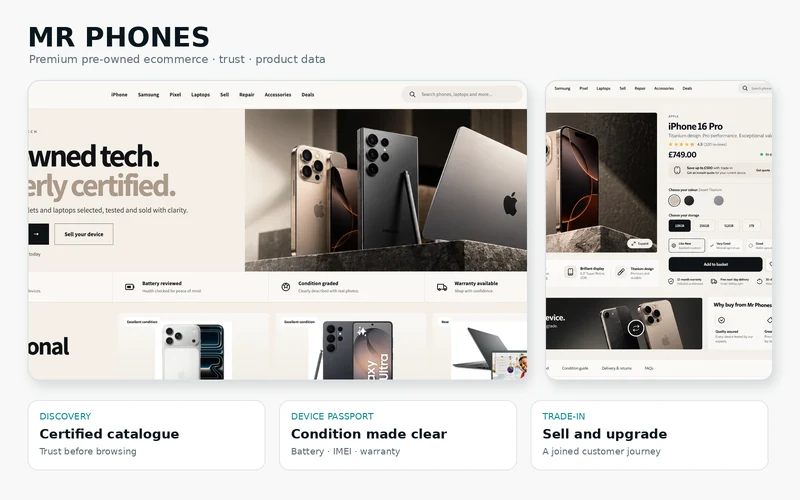
Want this applied to your business rather than just explained?
Merchant Center & product feedsCommon questions
Why are products disapproved in Merchant Center?
Common causes include policy issues, price or availability mismatches, missing or invalid identifiers, landing-page problems, shipping settings and data-quality errors.
Are GTINs always required?
No. Use valid identifiers when the product legitimately has them. Do not invent GTINs for products that do not.
What is the difference between a source feed and feed rules?
The source feed carries the underlying product data. Rules transform or supplement that data for a channel. Where possible, important recurring errors are better fixed in the source.
How often should feeds update?
Often enough that price and availability remain aligned with the website. The right schedule depends on how quickly stock and pricing change.