Quick answer: Shopify can remove a lot of technical friction, but choosing it does not decide how customers discover products, trust them, compare them or come back. The commercial and catalogue decisions still need making.
Plan the catalogue before importing products
Collections, product types, variants, attributes and filters determine whether the catalogue can be browsed sensibly. These decisions become harder to unwind after thousands of products are loaded.
Design the mobile PDP around decisions
Desktop has space to hide weak hierarchy. Mobile does not. Decide where price, options, delivery, trust, proof and Add to Cart belong before adding decorative sections.
Know which data must leave Shopify
If products feed Google Merchant Center, marketplaces or other channels, titles, identifiers and attributes need to be structured for more than the storefront. Build the source data with downstream use in mind.
Choose apps after defining the problem
Apps can solve real needs, but every dependency adds cost and operational complexity. Define the commercial requirement first, then decide whether the theme, an app or custom work is the smallest sensible answer.
Decide what success will be measured against
Before launch, define the actions that matter: product discovery, add-to-cart, checkout completion, repeat ordering or catalogue management efficiency. That keeps the platform decision connected to the business.
See our ecommerce approach and the Wellness ecommerce concept case study.
Five decisions to make before choosing apps
- How customers should browse the range.
- Which attributes need to power filters, search and external feeds.
- What a product page must prove before somebody buys.
- Which systems need to exchange inventory, orders or customer data.
- Which actions will define success after launch.
The Wellness ecommerce concept work is a useful example: “shop by goal”, routines and product proof are commercial architecture decisions. Shopify or WooCommerce can implement them, but neither platform invents them for the business.
Wellness ecommerce concept
Organise discovery around goals, proof and routines so the range feels curated rather than overwhelming.
View case study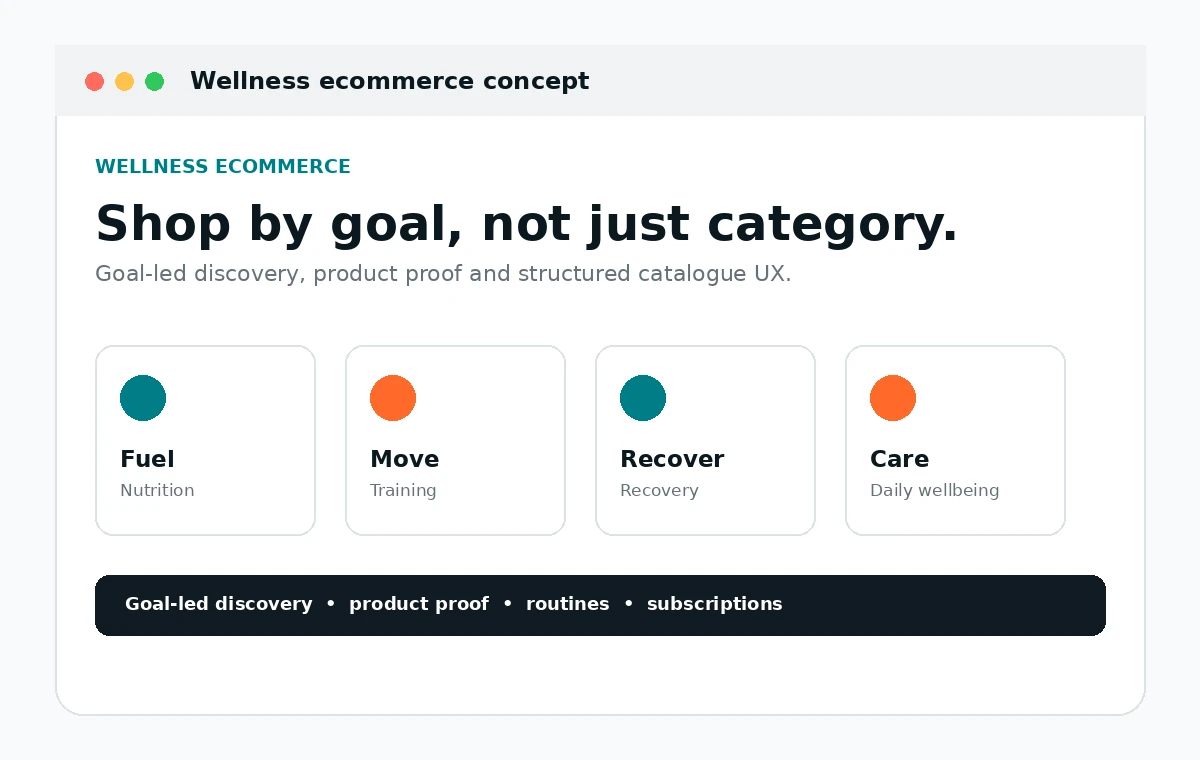
Want this applied to your business rather than just explained?
EcommerceCommon questions
Is Shopify good for small ecommerce businesses?
Often, yes. It removes a lot of infrastructure overhead, but catalogue design, product data, UX and commercial strategy still need to be planned.
Should we migrate to Shopify just because the current site is old?
No. Define the actual problems first. A migration is justified when the current platform is materially limiting operations, customer experience or growth.
How many Shopify apps should we use?
As few as the business genuinely needs. Each app adds cost, dependency and potential performance overhead.