More traffic is not always the next answer. An ecommerce business can attract a healthy number of visitors and still struggle because the buying journey, catalogue quality or channel setup prevents demand from becoming revenue.
Look at the journey, not one metric
Category navigation, product discovery, mobile product pages, delivery information, trust, checkout friction and merchandising should be reviewed together. A conversion problem can begin much earlier than the checkout.
Product data matters too
Feeds and Merchant Center are not back-office details. Titles, attributes, identifiers, categorisation, availability and landing-page consistency affect how products are understood and distributed across shopping channels.
Prioritise the constraint
The useful question is not “what can we optimise?” but “what is most likely to be limiting growth right now?” That is the basis of FifteenFold ecommerce consultancy.
Why ecommerce growth stalls even when the website still looks fine
Most ecommerce slowdowns do not arrive as one obvious failure. The store still loads, orders still come in, campaigns still spend and product pages still exist. The problem is usually that the commercial system has become harder for customers and platforms to understand. Search traffic softens, Shopping visibility becomes less reliable, conversion rate drifts down and the team responds by changing the surface instead of the constraint underneath.
That is why a redesign is often the wrong first move. A better first question is: where has confidence broken? Customer confidence, Google confidence, product-data confidence, pricing confidence, delivery confidence or internal decision confidence. Growth usually returns when the limiting layer is identified and fixed in the right order.
Six common reasons growth stalls
1. The catalogue grows faster than the structure
A small catalogue can survive loose categories, inconsistent titles and thin attributes. A larger catalogue cannot. Once variants, filters, product types and brand ranges multiply, the store needs a stronger product-data model. Without it, customers struggle to narrow choices and Google receives weak signals about what each item actually is.
2. Product pages answer the wrong questions
Many product pages describe the product but do not reduce buying risk. For ecommerce CRO, the page needs to answer comparison, compatibility, size, delivery, returns, proof and value questions at the point of hesitation. If customers still need to leave the page to feel confident, the page is leaking demand.
3. Merchant Center becomes the warning light
Disapprovals, price mismatches, missing identifiers and limited Shopping visibility are rarely isolated Merchant Center problems. They usually point back to source data, feed rules, structured data, variant handling or landing-page inconsistency. Treating each warning as a one-off fix creates recurring issues.
4. Paid traffic hides weak organic architecture
Paid campaigns can keep sales moving while organic search, category relevance and informational content fall behind. The danger is that the business starts paying repeatedly for demand it could have captured through better category pages, buying guides, comparison content and cleaner product data.
5. Mobile journeys become too long
On mobile, every extra tap is a tax. Customers need clearer filters, better product-card information, visible delivery and return reassurance, faster variant selection and fewer dead ends. A desktop-friendly journey can still be commercially weak if mobile users are doing most of the deciding.
6. Teams optimise separate pieces
The SEO person wants content, the paid media person wants cleaner feeds, the developer wants clearer requirements and the owner wants more sales. All may be right, but not all at the same time. Ecommerce growth stalls when there is no shared sequence across CRO, product data, feed quality, content and technical delivery.
The practical rule: diagnose before redesign. If the constraint is product data, a prettier theme will not fix Shopping visibility. If the constraint is trust, more traffic will not fix conversion. If the constraint is mobile decision friction, another homepage section will not fix product-page hesitation.
How to diagnose the constraint
| Symptom | Likely place to inspect first | Useful next step |
|---|---|---|
| Traffic is steady but sales are down | Product pages, checkout, pricing, delivery promise and trust signals | CRO review |
| Products are missing or limited in Shopping | Merchant Center diagnostics, feed attributes, identifiers and destination eligibility | Feed triage |
| Category pages rank but do not convert | Category intent, product-card data, filters and comparison support | Ecommerce consultancy |
| Paid campaigns need constant manual work | Feed rules, source data, product titles and variant structure | Review feed rules vs source data |
| The team cannot agree what to fix first | Commercial impact, effort, dependency order and measurement | Optimisation roadmap |
What good ecommerce growth work looks like
Good ecommerce optimisation is not a random list of tweaks. It normally follows a sequence: protect what already works, find the constraint, fix measurement, improve the highest-friction journey, clean the product data behind it, then build content and acquisition routes around the improved commercial structure.
For a Shopify or WooCommerce store, that might mean improving category routes and product-card data before touching the homepage. For a catalogue-heavy business, it might mean fixing identifiers, titles, product types and feed rules before adding more ad spend. For a local or specialist ecommerce business, it might mean building clearer service, category and advice pages so Google and customers understand the offer without guesswork.
The important point is that growth does not usually stall because one button is the wrong colour. It stalls because the store, the data and the acquisition channels stop reinforcing each other. Fix that system and the individual design changes start to matter again.
Related reading
Automotive decision platform
Make the decision itself clear, show the assumptions and put useful evidence before a sales route.
View case study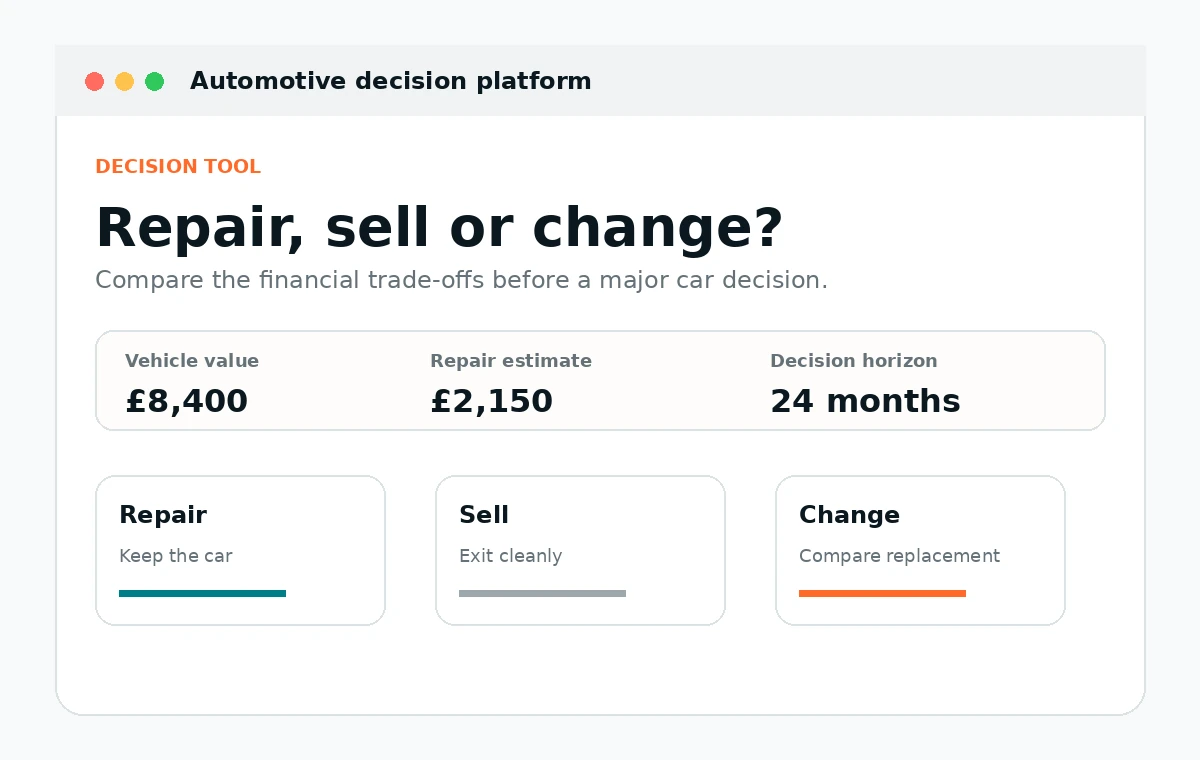
Want this applied to your business rather than just explained?
Websites